
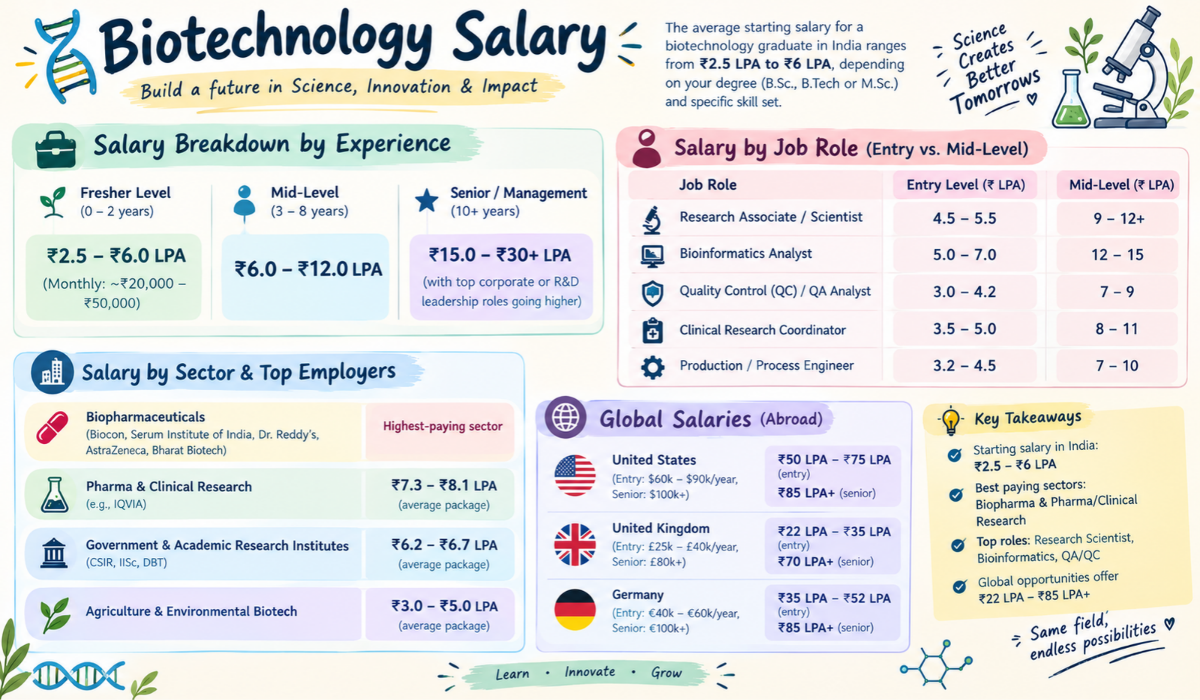
Biotechnology salary in India depends on educational qualifications, work experience, job role, technical skills, and employer. Graduates with B.Sc., B.Tech, or M.Sc. biotechnology degrees can explore opportunities in pharmaceuticals, research laboratories, healthcare, agriculture, and biotechnology companies. Freshers generally start with modest packages, while experienced professionals in specialised fields can earn higher salaries.
This guide covers biotechnology salary by experience, job role, company type, city, and monthly pay to help students and job seekers understand their career opportunities in India.
Biotechnology Salary in India
Biotechnology combines biology, technology, and scientific research to develop products and solutions for healthcare, agriculture, and other industries. Biotechnology graduates can work in laboratories, pharmaceutical manufacturing, quality control, clinical research, and bioinformatics.
The salary varies according to the degree, practical experience, and specialisation. The following table provides approximate annual salary ranges in India.
| Experience Level | Estimated Annual Salary |
| Biotechnology fresher | ₹2.5 lakh–₹6 lakh |
| Junior biotechnologist | ₹3 lakh–₹7 lakh |
| Mid-level professional | ₹6 lakh–₹12 lakh |
| Senior biotechnologist | ₹10 lakh–₹20 lakh |
| Research or technical manager | ₹15 lakh–₹30 lakh or more |
These figures are indicative estimates, not guaranteed packages. Research-focused roles and specialised positions may require postgraduate qualifications or additional training.
Read Also: Bipin Rawat Salary
Biotechnology Salary By Experience
Experience can improve earning potential in biotechnology because employers value practical laboratory skills, research knowledge, industry experience, and the ability to manage projects. Professionals who develop specialised expertise may qualify for better positions as their careers progress.
| Work Experience | Estimated Annual Salary |
| 0–2 years | ₹2.5 lakh–₹6 lakh |
| 3–5 years | ₹5 lakh–₹9 lakh |
| 5–8 years | ₹6 lakh–₹12 lakh |
| 8–12 years | ₹10 lakh–₹20 lakh |
| 12+ years | ₹15 lakh–₹30 lakh or more |
Salary growth depends on the employer, location, qualifications, and responsibilities. Professionals working in research leadership, bioinformatics, or biopharmaceutical development may have opportunities to earn more.
Biotechnology Salary for Freshers
Freshers with B.Sc. or B.Tech biotechnology degrees can apply for entry-level positions in laboratories, pharmaceutical companies, quality testing, production, and research support. Starting salaries are usually influenced by practical training, internships, communication skills, and the type of organisation hiring.
| Fresher Job Opportunity | Estimated Annual Salary |
| Laboratory assistant or trainee | ₹2 lakh–₹3.5 lakh |
| Quality control trainee | ₹2.5 lakh–₹4 lakh |
| Production trainee | ₹2.5 lakh–₹4.5 lakh |
| Research assistant | ₹2.5 lakh–₹4.5 lakh |
| Biotechnology graduate in a specialised role | ₹4 lakh–₹6 lakh |
Freshers can improve their job prospects by gaining laboratory experience, learning standard testing procedures, and completing relevant internships. An M.Sc. or specialised technical training may help candidates qualify for certain research and advanced laboratory roles.
Biotechnology Salary by Job Role
Biotechnology offers several career paths, and each role has different responsibilities and salary potential. Research, clinical research, quality assurance, and bioinformatics are common options, while production roles focus on manufacturing and process improvement.
| Job Role | Entry-Level Salary | Mid-Level Salary |
| Research associate or scientist | ₹4.5 lakh–₹5.5 lakh | ₹9 lakh–₹12 lakh+ |
| Bioinformatics analyst | ₹5 lakh–₹7 lakh | ₹12 lakh–₹15 lakh |
| Quality control or assurance analyst | ₹3 lakh–₹4.2 lakh | ₹7 lakh–₹9 lakh |
| Clinical research coordinator | ₹3.5 lakh–₹5 lakh | ₹8 lakh–₹11 lakh |
| Production or process engineer | ₹3.2 lakh–₹4.5 lakh | ₹7 lakh–₹10 lakh |
These ranges vary with qualifications and the employer. Bioinformatics positions often require computational skills, while research scientist roles may require a postgraduate degree or PhD for advanced responsibilities.
Biotechnology Salary by Company Type
The company you join can influence your salary, training opportunities, and career progression. Pharmaceutical and biopharmaceutical companies employ biotechnology graduates in research, production, quality control, and product development. Clinical research organisations and government research institutes offer additional career paths.
| Company or Sector Type | Estimated Annual Salary |
| Small laboratories | ₹2 lakh–₹4 lakh |
| Pharmaceutical companies | ₹3 lakh–₹8 lakh |
| Biotechnology companies | ₹3 lakh–₹10 lakh |
| Clinical research organisations | ₹3.5 lakh–₹11 lakh |
| Government and academic research institutes | ₹3 lakh–₹8 lakh, depending on the post |
| Specialised bioinformatics and research roles | ₹5 lakh–₹15 lakh or more |
Potential employers include Biocon, Bharat Biotech, Serum Institute of India, Dr. Reddy’s Laboratories, and clinical research organisations. Actual salaries depend on the position, experience, location, and recruitment terms.
Biotechnology Salary by City
Location can affect biotechnology salary because companies, research facilities, pharmaceutical manufacturing units, and clinical research organisations are concentrated in particular cities. Major biotechnology and pharmaceutical hubs may offer a wider choice of specialised jobs.
| City | Estimated Annual Salary |
| Bengaluru | ₹3 lakh–₹10 lakh |
| Hyderabad | ₹3 lakh–₹9 lakh |
| Pune | ₹3 lakh–₹8 lakh |
| Mumbai | ₹3 lakh–₹8 lakh |
| Chennai | ₹2.5 lakh–₹7 lakh |
| Delhi NCR | ₹3 lakh–₹8 lakh |
| Ahmedabad | ₹2.5 lakh–₹7 lakh |
These are broad indicative ranges rather than official city averages. Your actual salary will depend on the employer, job profile, qualifications, and relevant experience.
Monthly Salary of a Biotechnologist
The monthly salary of a biotechnology professional depends on the annual package and the components included in the offer. Employers often quote cost to company (CTC), which may include benefits and other payments in addition to fixed salary.
| Annual Package | Approximate Monthly CTC |
| ₹2.4 lakh | ₹20,000 |
| ₹3 lakh | ₹25,000 |
| ₹4 lakh | ₹33,333 |
| ₹6 lakh | ₹50,000 |
| ₹8 lakh | ₹66,667 |
| ₹10 lakh | ₹83,333 |
| ₹12 lakh | ₹1,00,000 |
Monthly CTC is calculated by dividing the annual package by 12. The actual in-hand salary may be lower because of provident fund contributions, taxes, insurance, and other deductions. Always review the salary breakup before accepting an offer.
Skill-Based Biotechnology Salary
Technical skills can help biotechnology graduates qualify for specialised roles. Employers may look for knowledge of laboratory procedures, molecular biology, microbiology, data analysis, quality standards, or computational tools, depending on the job.
| Skill | Common Career Opportunities |
| Molecular biology | Research and laboratory roles |
| Microbiology | Quality testing and pharmaceutical production |
| Cell culture | Biopharmaceutical research and manufacturing |
| Quality assurance and control | Pharmaceutical and biotechnology quality teams |
| Clinical research | Clinical research coordination and trial support |
| Bioinformatics | Biological data analysis |
| Biostatistics and data analysis | Research and clinical data roles |
| Good Laboratory Practice (GLP) | Laboratory testing and research support |
Learning a skill alone does not guarantee a higher salary. Practical experience, recognised training, and the ability to apply these skills in a professional setting also matter.
Factors Affecting Biotechnology Salary
Biotechnology salary in India depends on several factors, including education, experience, skills, and the type of company. The main factors affecting salary are:
- Education: Qualifications such as B.Sc., B.Tech, M.Sc., or PhD.
- Experience: Practical work experience and industry knowledge.
- Specialisation: Expertise in bioinformatics, research, or biopharmaceuticals.
- Company type: Salary differences between pharmaceutical companies, biotech firms, and research institutes.
- Location: Job demand and opportunities in different cities.
- Technical skills: Laboratory techniques, research methods, and data analysis.
- Communication skills: Teamwork, reporting, and problem-solving abilities.
How to Increase Your Salary in Biotechnology

Biotechnology graduates can improve their earning potential by developing industry-relevant skills and gaining practical experience. Choosing a specialisation that matches your interests can also help you identify suitable jobs and further training opportunities.
Biotechnology professionals can improve their salary and career opportunities by following these strategies:
- Gain practical experience: Complete internships and laboratory training to develop hands-on skills.
- Improve technical skills: Learn relevant laboratory testing, research methods, and data analysis.
- Choose a specialisation: Explore bioinformatics, clinical research, or biopharmaceuticals.
- Consider higher education: Pursue an M.Sc. or PhD if it supports your career goals.
- Learn industry standards: Understand quality control procedures and laboratory practices.
- Build professional connections: Attend scientific events and connect with industry professionals.
- Prepare for interviews: Practise technical questions and explain your projects confidently.
- Compare job offers: Review salary, benefits, location, and career growth opportunities.
Before enrolling in an additional course, make sure it matches your preferred career path. Practical experience and relevant skills can be just as important as additional qualifications.
Career Growth Opportunities
Biotechnology professionals can progress from entry-level laboratory and production roles into specialised research, quality management, project coordination, or leadership positions. The route depends on their qualifications, work performance, and chosen area of specialisation.
Biotechnology professionals can progress through different career stages as they gain experience, technical skills, and qualifications.
- Entry level – Laboratory Trainee: Assists with routine laboratory work and basic testing.
- Early career – Research or QC Associate: Conducts experiments and performs quality checks.
- Mid-career – Senior Research Associate: Manages experiments and analyses research results.
- Advanced technical – Scientist or Specialist: Leads technical tasks and research projects.
- Management – Laboratory or Quality Manager: Supervises teams and maintains quality standards.
- Senior research – Research Lead or Director: Manages research programmes, teams, and scientific strategies.
Some advanced research positions require a PhD or specialised experience. In contrast, professionals in quality control and production can progress through industry experience, technical training, and strong performance.
FAQ About Biotechnology Salary in India
Q1. What is the average biotechnology salary in India?
Entry-level biotechnology professionals may earn around ₹2.5 lakh–₹6 lakh per year. Experienced professionals can earn ₹6 lakh–₹12 lakh or more, depending on their role, skills, and employer.
Q2. What is the starting salary for a biotechnology fresher?
A biotechnology fresher may earn approximately ₹2.5 lakh–₹4.5 lakh annually in many entry-level laboratory, production, or quality roles. Some specialised positions offer higher packages.
Q3. Can a biotechnologist earn ₹1 lakh per month?
Yes. A package of ₹12 lakh per year equals ₹1 lakh in monthly CTC before deductions. However, reaching this level usually requires relevant experience, specialised skills, or a suitable higher-paying role.
Q4. Which biotechnology job pays the most?
Specialised bioinformatics, biopharmaceutical research, senior scientific positions, and research management can offer competitive salaries. Pay varies according to qualifications, experience, and the employer.
Q5. Is biotechnology a good career in India?
Biotechnology can be a suitable career for people interested in biology, research, healthcare, and scientific applications. Job opportunities exist in pharmaceuticals, diagnostics, clinical research, agriculture, and biotechnology development.
Q6. Which degree is best for a biotechnology career?
B.Sc. and B.Tech degrees can lead to entry-level roles, while an M.Sc. may help with specialised laboratory and research positions. A PhD is useful or required for certain advanced research careers.
Conclusion
Biotechnology salary in India depends on education, experience, technical skills, job role, and company type. Freshers commonly start with annual packages of ₹2.5 lakh–₹6 lakh, while experienced professionals in specialised or management positions may earn considerably more.
To improve your career prospects, focus on practical training, relevant technical skills, and a specialisation that matches your goals. Compare salary structures and job responsibilities before accepting an offer, and choose opportunities that support both professional learning and long-term growth.
Read Also: GST Inspector Salary in India