
Life at sea is a career that holds plenty of mystery for Indian families. You listen to stories about new officers making lakhs a month, captains bringing home even more, and months off with full pay off between trips. Much of it is true, and some of it is hype! The guide below details the merchant navy salary in India without any sugar-coating, so that you have realistic expectations before planning a career or a course choice.
To understand this, here is the first point: it’s not a consistent government pay scale as we have in other jobs, but also an all-inclusive listing of merchant navy salary. Freight firms determine their own contracts, and most make payment in US dollars. This is why multiple websites quote very different numbers for the same rank. The ranges below are general averages based on career guidance and industry data. Review any offer letter or company contract first!
What Is the Merchant Navy?
Merchant Navy is the commercial aspect of shipping. This has nothing to do with combat – its vessels are propelled by cargo, oil, gas, and passengers around the world. This is not comparable to the Indian Navy, which falls under our armed forces. Merchant navy personnel are not to be confused with regular shipping employees; they find jobs in shipping companies, and their services are regulated by Directorate General of Shipping.
Four departments are required to run a ship: the deck department (navigation or cargo), engine department (engine, machinery and repairs), electro-technical department (electrical systems), and various general purpose crews for day-to-day life support. Every department or segment of merchant navy has its own ladder, which means salary you draw is based on the one you work in.
Merchant Navy Salary: Deck Department
The deck side leads to the captain’s chair. New officers come on the lower rungs, as cadets, and can be promoted with sea time and by successfully passing competency exams.
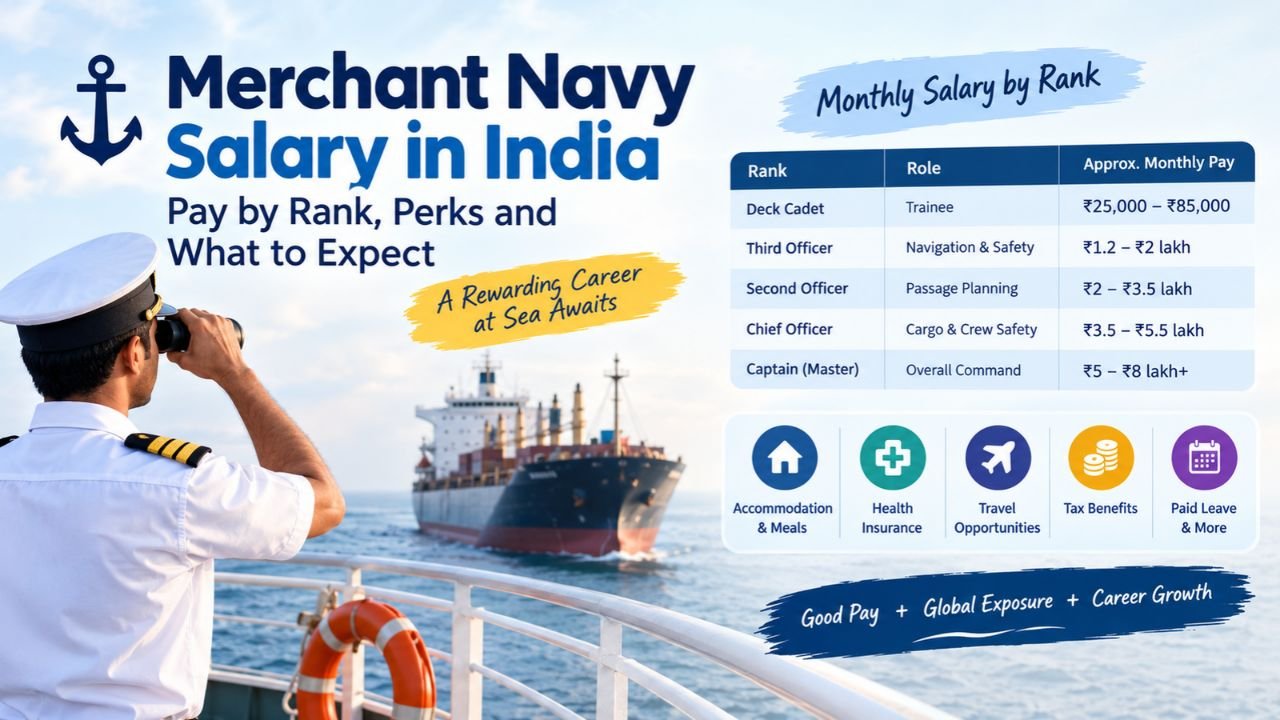
Deck department salary progression (approximate monthly pay)
| Rank | Role in brief | Approximate monthly range |
| Deck Cadet | Trainee learning on board | ₹25,000 – ₹85,000 |
| Third Officer | Navigation watch, safety equipment | ₹1.2 – ₹2 lakh (some companies pay more) |
| Second Officer | Passage planning, navigation | ₹2 – ₹3.5 lakh |
| Chief Officer | Second-in-command, cargo, crew safety | ₹3.5 – ₹5.5 lakh |
| Captain (Master) | Overall command of the ship | ₹5 – ₹8 lakh and above |
Others cite higher numbers, especially for tanker and gas-carrier jobs – a captain is reported to earn far more than ₹8 lakh a month. Others cite less generous ranges, particularly for smaller operators. The frank summary is that the captain of a merchant navy salary begins about ₹5 lakh and, with sounds kind of ship and company navigating very quickly additional.
Merchant Navy Salary: Engine Department
Marine engineers maintain propulsion and power systems, and the pay is equally handsome.
Engine department salary progression (approximate monthly pay)
| Rank | Role in brief | Approximate monthly range |
| Engine Cadet | Trainee in the engine room | ₹25,000 – ₹70,000 |
| Fourth Engineer | Junior engine watch | ₹1.2 – ₹3.5 lakh |
| Third Engineer | Machinery and auxiliary systems | ₹2 – ₹4.5 lakh |
| Second Engineer | Day-to-day maintenance planning | ₹3.5 – ₹8 lakh |
| Chief Engineer | Head of the engine department | ₹5 – ₹12 lakh and above |
Those huge gaps show just how differently companies pay. The salary you will get as a fourth engineer in merchant navy on a small coastal vessel has very little resemblance to what you would earn as the same rank (4th engineer) on a large tanker with an international operator.
Ratings and Entry-Level Roles
Not everyone enlists as an officer. Ratings, those involved in deck and engineering work that requires less training, also do relatively well by wage comparison to many shore jobs on a level playing field of qualifications.
General Purpose (GP) Rating: ₹25,000 to ₹60,000 per month during the initial phase
Able Seaman: around ₹65,000 to ₹1.3 lakh per month with experience
Most common: ₹25,000-₹85,000 band (will depend on company policy) cadets and trainees
Think of it not much as a complete officer package but more like paid training as a cadet for a fresher. The salary of a trainee merchant navy officer is significantly less than that from an officer but rises steeply following the first certificate of competency.
What Affects the Merchant Navy Salary?
This means that two people with exactly the same rank could earn vastly different amounts. These factors explain why.
Key factors that change pay
| Factor | How it affects pay |
| Ship type | Tankers, chemical carriers and gas carriers usually pay more than general cargo or bulk ships |
| Company | Large international operators generally pay more than smaller local firms |
| Rank and certificates | Higher licences and endorsements unlock higher pay |
| Sea experience | Time spent on board raises both eligibility and offers |
| Contract length | Longer contracts can mean higher total earnings |
| Currency | Many companies pay in dollars, so the rupee value shifts |
The ship type is the largest swing factor. More training and endorsements are needed for dangerous cargo, and that expertise costs companies. Before weighing in on the merchant navy salary by way of ranking, those studying to be a part of this fine industry must know which sort of vessel they would potentially be a part of.
Understanding Contracts And Annual Salary
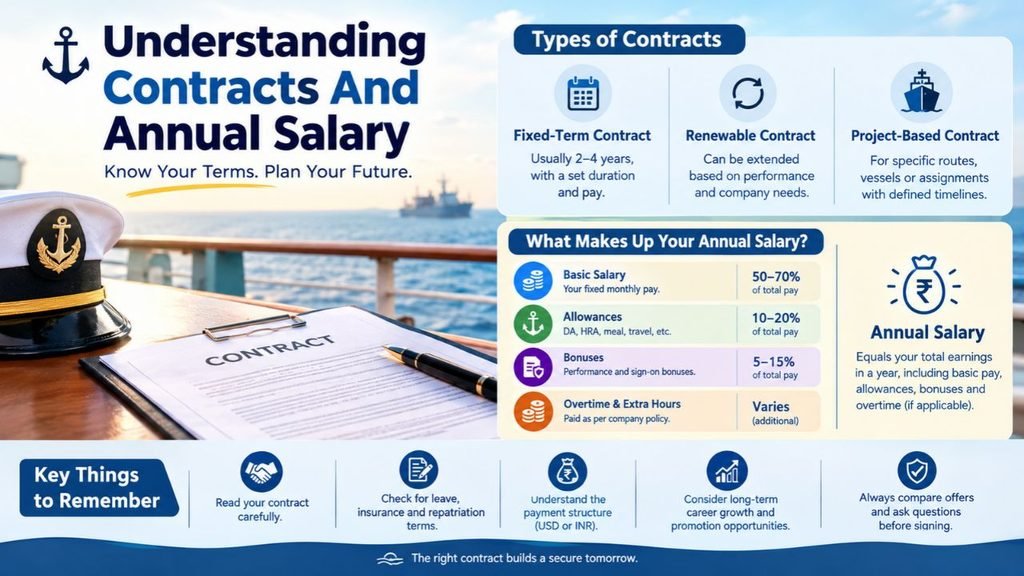
This is because the work in merchant navy runs on contracts. An officer could stay aboard for as long as four months or more, although typically between four and nine, depending upon the company and rank; this was followed by a period of leave spent at home. Generally salary is paid for time on board and many places offer a few weeks of leave as part of the deal.
Annual income therefore is not just twelve times the monthly number. A third officer drawing ₹1.5 lakh per month who sails for eight months in a year has approximately ₹12 lakh, not considering leave. Think of each annual estimate as a ballpark number. A senior officer in the merchant navy is reported to earn more than ₹2 crore a year on some websites, but this is only possible for experienced captains or chief engineers of expensive vessels.
Is the Merchant Navy Salary Tax-Free?
You will often see the claim that seafarers pay no tax. This is only partly true. As per Indian tax law, your tax treatment depends on whether you are a non-resident or not – which is based on how many days you spend outside of India. Seafarers manning foreign-going vessels who are away from their ship for long stretches can be non-resident, and thus income earned outside India will not be subject to tax in India.
That depends very much on your contract, and what type of ship you are sailing on (i.e., charter), how many days of stay (days at port) + current regulations that differ per year. Would one be treated differently if they were on an Indian vessel on the high seas? Before you make plans around a tax-free merchant navy salary, check if the chartered accountant you speak with has knowledge of seafarer taxation.
Career Growth Timeline
Sea time and exams, not years, hold the key to sea progress. The common path looks like this.
Typical career timeline
| Stage | Approximate years from joining | Typical rank |
| Training | 0 to 2 years | Cadet or trainee |
| Junior officer | 3 to 5 years | Third and Second Officer, or Fourth and Third Engineer |
| Senior officer | 6 to 10 years | Chief Officer or Second Engineer |
| Command level | 10 to 15 years | Captain or Chief Engineer |
People who clear exams first and get uninterrupted sea time due to their diversity in getting a quicker promotion, whereas waiting on berths could take longer. The initial amount is less impactful than the speed of progression, as merchant navy salary increases at every level.
Ways to Join: Routines and qualifications
Since this is strictly regulated and eligibility is determined by both DG Shipping and the approved institutes, make sure you read recent guidelines before applying. The common routes are below.
Common entry routes (verify current rules)
| Route | Typical qualification | Leads to |
| Deck officer | 12th with Physics, Chemistry, Maths and English, then a nautical science degree or diploma | Deck Cadet, then Third Officer |
| Marine engineer | BTech in Marine Engineering, or an approved pre-sea course after a relevant degree | Engine Cadet, then Fourth Engineer |
| Electro-technical officer | Electrical or electronics degree plus ETO training | Electro-technical Officer |
| GP rating | 10th pass plus a pre-sea course | GP Rating, then Able Seaman |
For IMU (Indian Maritime University), admission criteria include an entrance test (IMU CET), Medical fitness, Age limits etc. Candidates require documents like a Continuous Discharge Certificate and must undergo safety courses. While you are looking for the options, keep in mind that the salary of merchant navy can greatly vary with intended course being completed as courses which are not approved do not provide valid certificate.
Benefits Beyond the Paycheck
Money does not tell the whole story of what pulls people to sea.
- Long leaves. So, the time it takes to be back home between two contracts is almost always extremely high.
- Travel. You make port in various countries.
- Free on-board accommodation and meals. The cost of living is extremely low on the oceans.
- Medical and insurance cover. Multiple companies offer full health and accident cover.
- Strong progression. With every certificate, there is a clear increase in pay.
The Downsides to Consider
Equally, the other side is needed for a balanced picture.
- Time away from family. Relationships can suffer from months at sea.
- Isolation. Advances in internet and communication (but still limited on some ships)
- Demanding work. Logistics and weather clearly conspire to make the job physically exhausting.
- Risk and responsibility. They are strict on the regulations of safety and environmental issues.
- Uncertain placement. A course does not guarantee a job, as it is limited by cadet berths.
Compare these against the merchant navy salary prior to making any commitments whatsoever. It is not a casual profession, but the trade-off is worthwhile for the right person.
Also Read: GST Inspector Salary | Bipin Rawat Salary | Biotechnology Salary in India
Conclusion
On average, the Merchant navy salary in India is at baseline-level for cadets and steadily increases with each issued certificate to lakhs a month for senior officers. Numbers vary by specific company, vessel type and contract, so take all the numbers you read – including the ones here, as guide rather than gospel.
This can be a great job for people who want travel, responsibility, and good earnings potential (depending on the industry), but are willing to spend long periods away from home. Take one of the recognised institutes and read their latest eligibility criteria, talk to some of the working seafarers to know what the actual merchant navy salary is in his company before you take any decision.
Frequently Asked Questions
1. What is the initial salary of a merchant navy for fresher?
Basically, freshers like deck cadets, engine cadets and GP ratings usually start their salary between ₹25,000 and ₹85,000 per month, depending on the company.
2. How much does a captain make in merchant navy salary?
₹5 to ₹8 lakh per month and above for specialist roles with some specialised ships even paying much higher.
3. Do chief engineers receive captain money?
Generally yes. Chief engineers typically fall into a similar bracket, earning anywhere between ₹5 lakh to over ₹10 lakh per month.
4. Does the salary of merchant navy come in dollars?
Also, Most of the companies pay in US dollars and some Indian companies paid in rupees. This influences the rupee value you will get.
5. How shady is the merchant navy salary in India?
Not automatically. Talk to your chartered accountant about that matter; this will depend on alien status and the existing tax legislation in the current working zone.



2 thoughts on “Merchant Navy Salary in India: Pay by Rank, Perks and What to Expect”