
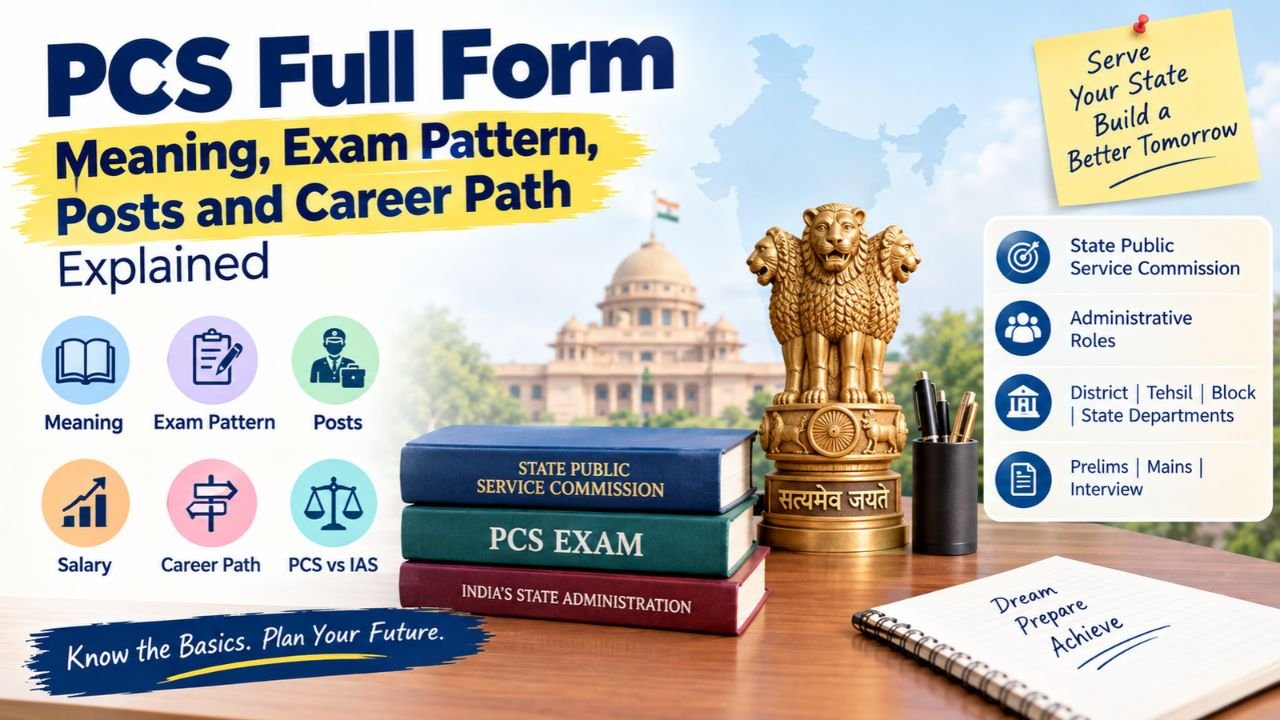
Walk into any coaching center in Prayagraj, Patna, or Lucknow and you will see the three letters PCS spoken of more often than anything else. You will hear students talking about PCS over cups of tea, parents asking about it during wedding receptions, and newspapers declaring its results with large headings. However, many individuals still hesitate when they are asked to define PCS, or they mistake it for the IAS.
The PCS full form, what the service does, which exam is used for entry into the service, the types of jobs available through the service and how it is different from the IAS will be covered in this guide. Also, some other definitions of the PCS full form will be examined because these letters appear in other areas as well. Since each state has different rules regarding exams and those rules may vary from year to year, please verify all information regarding the exam by reviewing the official notification of your state commission.
What Is the PCS Full Form?
The PCS (Provincial Civil Service) is the name given to the civil service of an Indian state. Officers for this service are selected through the State Public Service Commission of each state. Although some states use a different name for the civil service than PCS, they will be listed here.
The term “provincial” was used to refer to a region of India that was being ruled by the British during the colonial era. After India became independent, this term was retained. Today, people use the term “provincial” to describe the civil service at the state level. Therefore, when you hear about the PCS full form, please keep in mind that the PCS is not part of the central government. Rather, the PCS is administered by the state government, with some officers having the opportunity to advance into the IAS.
Other Meanings of PCS
In addition to the exam notice, the abbreviation can appear in other situations as well. When you see PCS outside of an exam notice, there are likely a couple of possibilities for what you have seen.
Common meanings of PCS
| Context | What PCS stands for |
| Indian state administration | Provincial Civil Service |
| Medicine | Post-Concussion Syndrome |
| Telecom | Personal Communications Service |
| US military | Permanent Change of Station |
| Engineering | Power Conversion System |
| Business and software | Process Control System |
In daily Indian conversations, the PCS full form is nearly always synonymous with Provincial Civil Service. The other definitions are used in specialized areas, and you can tell what the PCS is referring to by the context of your discussion.
What Does the Provincial Civil Service Do?
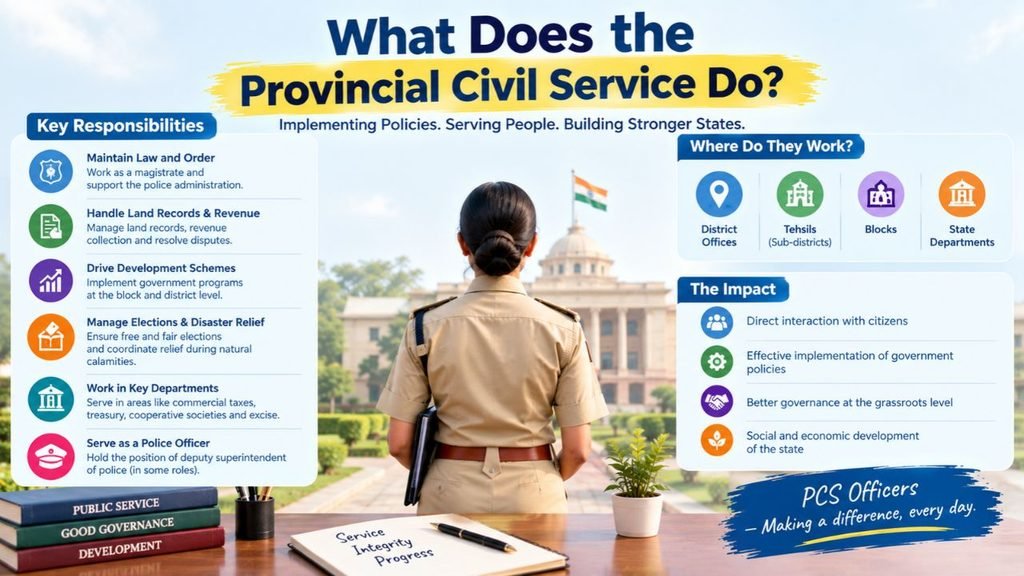
PCS officers manage the routine operations of a state government. They are assigned to districts, tehsils (sub-districts), blocks and state departments, and execute government policies at the local level. The duties associated with a PCS officer’s position depend upon the role.
- Maintaining law and order as a magistrate
- Handling land records, revenue collection, and disputes
- Running development schemes at the block and district level
- Managing elections and relief work during disasters
- As well as other major departments like Commercial Taxes, Treasury, Cooperative Societies and Excise
- Serving as a police officer at the deputy superintendent level
Officers are hands-on, interacting directly with citizens, and this is what appeals to some who want to enter the profession. Knowing what the PCS full form means is the beginning; however, understanding the role of an officer will help determine if the profession would be right for you.
Which Exam Leads to PCS?
The public service commissions of each state recruit for positions within their respective states. Recruitment is divided into three parts: a preliminary examination, a main examination, and an interview. In general, the exams will cover areas such as history, geography, politics, economics, science, current events, and information about the particular state.
For instance, the Uttar Pradesh Public Service Commission’s Uttar Pradesh PCS Exam is conducted based on the following pattern. State-by-state variations exist regarding number of papers and total marks, therefore consider this as a representative sample and not a universal standard.
Example exam structure (UP PCS pattern)
| Stage | Papers | Marks |
| Preliminary | General Studies Paper I | 200 |
| Preliminary | General Studies Paper II (CSAT), qualifying | 200 |
| Mains | General Hindi | 150 |
| Mains | Essay | 150 |
| Mains | General Studies, six papers at 200 each | 1,200 |
| Mains total | Eight papers | 1,500 |
| Interview | Personality test | 100 |
The prelims is merely an initial screening exam as the results of the preliminary exam will not affect your overall score. It is the mains exam scores and the interview process which will determine where you place in the final ranking. All applicants who are studying the PCS full form and intend to apply should download the current syllabus and format from the official state commission site before beginning.
PCS Names in Different States
The name of the service varies from state to state. While some use PCS (Professional Credentialing Services), other states have created their own names for the service. As a result, there is a lot of confusion when students try to compare exams taken in different states. Although the service functions the same way, the name and commission used by each state are different.
State civil services and the commissions that conduct them
| State | Common name of the exam | Conducting body |
| Uttar Pradesh | UP PCS | UP Public Service Commission |
| Uttarakhand | Uttarakhand PCS | Uttarakhand Public Service Commission |
| Bihar | BPSC | Bihar Public Service Commission |
| Madhya Pradesh | MPPSC (State Service) | MP Public Service Commission |
| Punjab | Punjab PCS | Punjab Public Service Commission |
| Rajasthan | RAS | Rajasthan Public Service Commission |
| Haryana | HCS | Haryana Public Service Commission |
| West Bengal | WBCS | West Bengal Public Service Commission |
| Karnataka | KAS | Karnataka Public Service Commission |
| Maharashtra | MPSC State Services | Maharashtra Public Service Commission |
When someone from outside of these states is speaking of the PCS full form, it is likely that they are speaking in reference to the general concept of a State Civil Service, and not necessarily the specific title of the examination that is administered locally.
Posts You Can Get Through PCS
The posts vary based upon the state you reside in and what position you have within the organization. However, the above list is representative of the most common posts. All posts may not be available each year or in every state.
Typical posts and where they sit
| Post | Department or area |
| Sub-Divisional Magistrate (SDM) or Deputy Collector | Revenue and general administration |
| Deputy Superintendent of Police (DSP) | Police |
| Block Development Officer (BDO) | Rural development |
| Assistant Commissioner (Commercial Tax) | Taxation |
| District Panchayat Raj Officer | Panchayati Raj |
| Treasury Officer | Finance |
| District Food and Marketing Officer | Food and civil supplies |
| Assistant Regional Transport Officer | Transport |
After the results have been announced, candidates fill out their preference forms. The placement of candidates into positions is based upon how high they ranked in the exam. In general, candidates with the highest ranks receive the most desirable positions (SDM, DSP). If you know what “PCS” stands for and what types of jobs are available through PCS, then you will be able to make a realistic plan for filling out your preference form.
PCS Salary and Benefits
The amount of money you earn is based on the state’s compensation policy. Most states have adopted the Central Pay Commission’s wage structure. The starting position for most PCS jobs like Deputy Collector, SDM, and DSP usually fall into Level 10 of the pay matrix. The salary range for these types of positions is between ₹56,100 and ₹1,77,500. However, every state sets its own salary ranges and allowances. In addition to your regular base salary, you will receive additional compensation for things like Dearness Allowance (DA), House Rent Allowance (HRA), etc.
Officers receive a government-provided home in many locations, a government-provided vehicle for on-the-job use, medical care, and retirement benefits according to state regulations. Throughout their careers, officers can earn promotions that lead to higher pay rates, and some may ultimately become senior-level officials such as an Additional District Magistrate or Department Head. Pay and benefits are two of the reasons why individuals spend years pursuing the PCS full form objective; however, it is recommended to review your state’s current pay regulations to obtain precise financial figures.
PCS vs IAS: What Is the Difference?
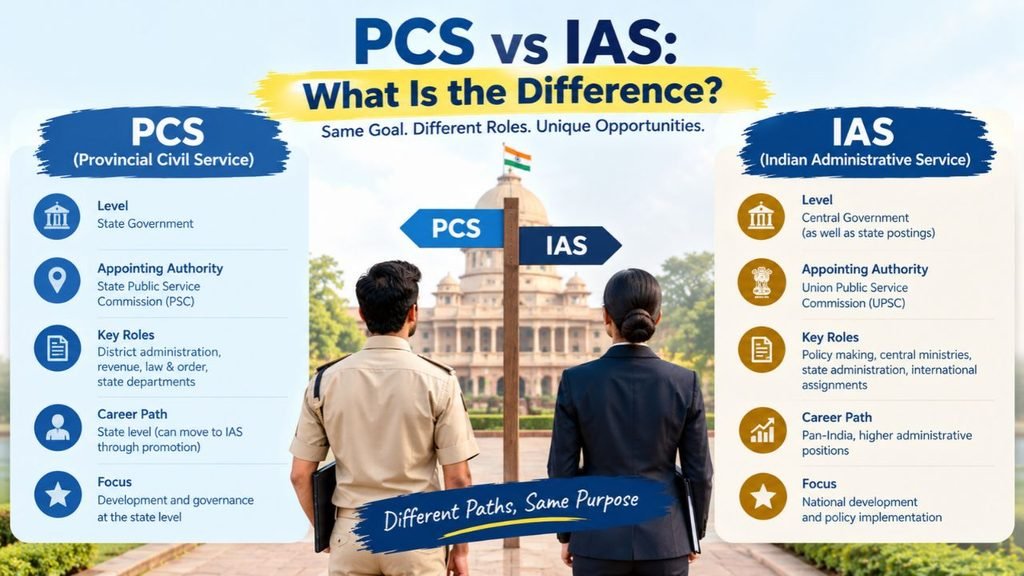
People often confuse these two types of services. The IAS is an all-India service that is recruited through the Union Public Service Commission (UPSC). Officers can be assigned to work in any state in India or directly for the federal government. On the other hand, PCS officers are recruited through state-level commissions and typically serve within their home states.
- Recruitment: UPSC for the IAS, the State Public Service Commission for PCS.
- Service area: The IAS serves across India, while PCS officers generally stay in one state.
- Starting posts: IAS officers typically start as either Assistant Collector or SDM, while PCS officers can start as SDM, DSP, BDO, etc.
- Promotion Path: There is a certain percentage of IAS vacancy positions reserved for State Civil Service Officers (PCS) to be promoted from within, after having served for many years. This allows PCS officers to obtain promotion into the IAS.
So, the PCS full form refers to a state-level service that can lead to the highest level of administration in the country; however, not all PCS officers have the chance to achieve this.
Eligibility in Brief
Rules vary depending on the state and year. However, all rules tend to have some similarities. It is important to review the most recent notification for specific details.
- Education: A bachelor’s degree from a recognised university
- Age: Often around 21 to 40 years for the general category in states like Uttar Pradesh, with relaxations for reserved categories and some other groups
- Nationality: Indian citizen
- Attempts: Some states limit the number of attempts, while others don’t
- Domicile and language: Some states have local requirements
The age restrictions on who can apply for a position will vary from one hiring cycle to another. It’s important to read through all of the information contained within each notification to ensure that you are aware of both the maximum age limit as well as any relaxation in that limit. If you simply know PCS full form and don’t pay attention to the details provided in each notification, then you may miss a deadline or apply for a position for which you are not qualified.
How to Start Preparing
A few habits help from day one.
- Read the official syllabus and previous year papers from your state.
- Build the basics with NCERT books for history, geography, polity and science.
- Read about what’s going on in the world every day by following the news in a trustworthy newspaper. Be sure to pay special attention to stories that are about your home state.
- Practise answer writing early, since the mains is descriptive.
- Take mock tests to build speed and accuracy.
- Stay consistent. A steady routine over a long period beats short bursts.
The PCS full form is just the first step. To prepare effectively, you need to regularly revise and practice.
Also Read: Merchant Navy Salary | GST Inspector Salary | Software Engineer Salary
Conclusion
The PCS full form is Provincial Civil Services, and this examination is a gateway to several of the highest-ranking administrative positions within a state. It provides a combination of power, public service and job stability. Those who have advanced to higher levels can also apply for the IAS. This is a very competitive route and takes time; therefore, rely on your state commission’s official notification instead of what others say.
If you are considering this profession, first take a look at the syllabus, then prepare accordingly, and keep yourself informed of current events. When you understand the PCS full form and the history associated with it, you will be in a much better place to determine if this path is right for you.
FAQs PCS Full Form
1. Can a PCS officer become an IAS officer?
Yes, through promotion. Some IAS positions are filled by state civil service officers who have served for several years.
2. What posts do PCS officers hold?
Posts are generally typical for SDM or Deputy Collector, DSP, Block Development Officer, Assistant Commissioner, and Treasury Officer.
3. Do all states use the name PCS?
Some states may refer to their state civil service as RAS, HCS, WBCS or KAS.
4. What is the PCS full form in medicine?
In healthcare, the term PCS can be used to refer to Post Concussion Syndrome, but this has nothing to do with the civil service.
5. How many stages are there in the PCS exam?
There are three parts to the exam: preliminary, main, and interview. However, the process can vary slightly depending on which state you take the exam in.
One thought on “PCS Full Form: Meaning, Exam Pattern, Posts and Career Path Explained”